Why agency timesheets lose billable context
Turn time entries into a useful delivery record with stable workstreams, concise outcome notes, and timely review.
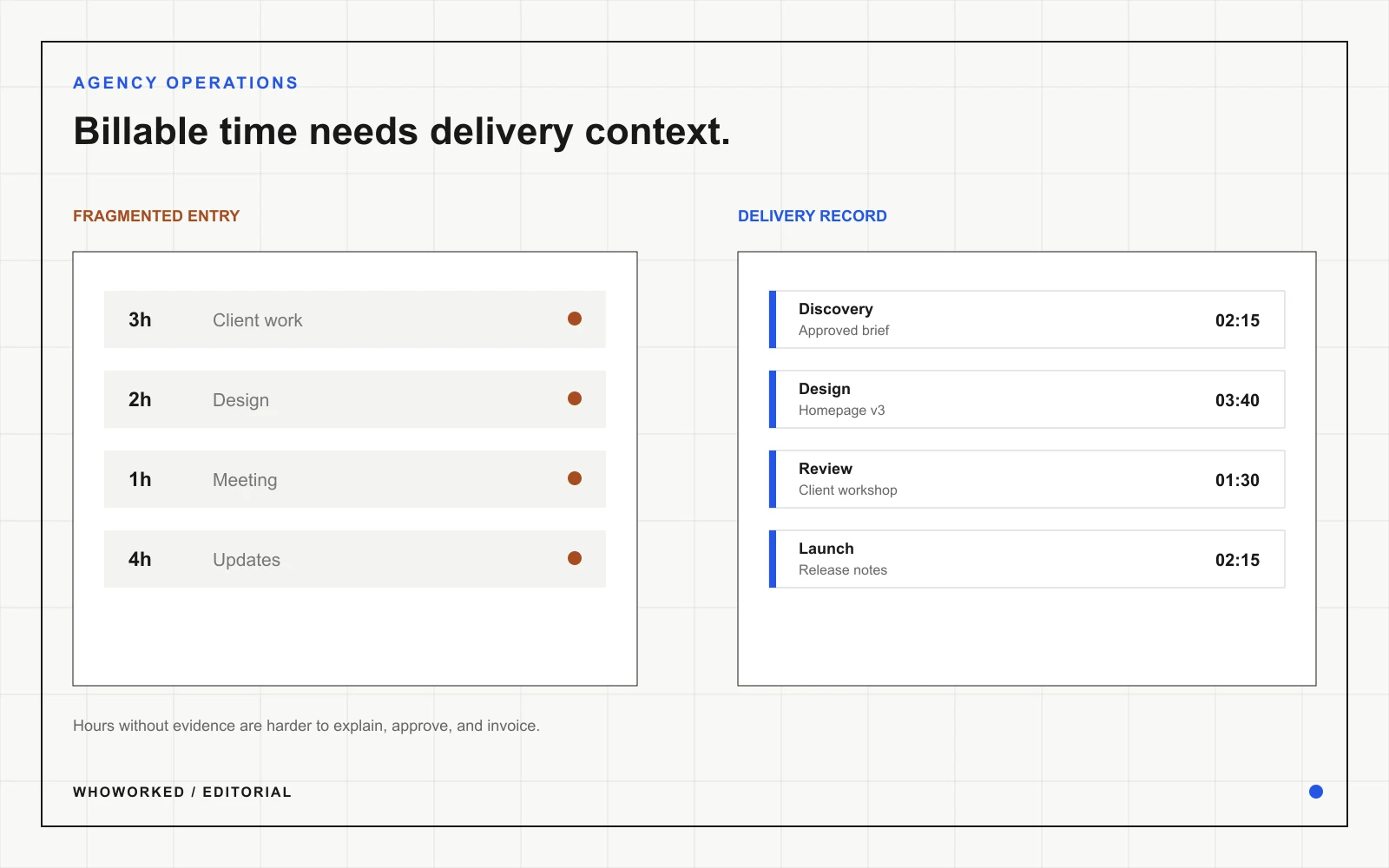
Most agency timesheets can total hours correctly and still fail at the moment they matter. A client asks why discovery exceeded the estimate, a delivery lead needs to forecast the next phase, or finance challenges an invoice. The report shows 42 hours against a project, but not what changed, what was decided, or what those hours produced.
The problem is missing delivery context
Traditional time entry forms optimize for allocation. They ask for a project, a broad task label, a duration, and perhaps a note. That is enough to assign cost, but not enough to reconstruct delivery. When every entry says design, development, or meeting, the useful story remains in Slack threads, tickets, documents, and individual memory.
This gap becomes visible late. During the week, everyone knows that the client changed the approval route or that an integration behaved differently from its documentation. At billing time, that shared context has faded. The agency then spends non-billable time rebuilding an explanation from scattered systems.
Structure time around workstreams
Projects are usually too broad for useful analysis, while ticket-level tracking is too fragile for billing. Workstreams provide the middle layer. They represent durable categories of delivery inside a project: strategy, research, content, design, implementation, quality assurance, account management, or another vocabulary your team already uses.
A workstream should survive changes to the backlog. Tickets can be split, renamed, or closed, but the reporting question remains stable: how much effort went into research compared with implementation, and why? This makes estimates and actuals comparable without forcing the timesheet to mirror the project-management system.
Write notes around outcomes and change
A strong note is brief. It states the outcome, the relevant scope, and any change that affects cost or schedule. For example: revised onboarding flow after stakeholder review; added two approved edge cases; prepared prototype for Friday decision. The note does not need to become a diary or duplicate the ticket description.
When work exceeds the plan, record the reason while it is fresh. Distinguish agency rework from a new client request, technical uncertainty, or a dependency outside either party's control. The distinction supports an honest commercial conversation and gives the team better evidence for the next estimate.
Project: Northstar product launch
Workstream: Quality assurance
Duration: 2h 15m
Outcome: Retested checkout after payment-provider update; documented three browser-specific failures.
Change: Unplanned vendor behavior, raised with client and added to risk log.
Create a lightweight review rhythm
Do not wait until month end to inspect the record. Delivery leads should review unsubmitted time, unusual workstream variance, and entries without useful outcomes at least weekly. The review is fastest when it happens close to the work, and it prevents finance from becoming the first team to discover a delivery issue.
Use exceptions rather than reading every line. Look for projects approaching budget, workstreams that moved sharply from estimate, long entries with generic notes, and substantial unbillable time. Each exception should lead to a decision: clarify scope, change staffing, update the forecast, or improve the operating process.
Make client reporting selective
Internal context can be richer than the client-facing report. Clients usually need a clear summary by project and workstream, important outcomes, approved scope changes, and progress against the commercial model. They rarely need every internal note. Design the entry once, then choose the right level of detail for each audience.
Consistency matters more than volume. Agree on workstream names, write examples of good notes, and decide which changes require explicit mention. A report built from consistent records feels deliberate. A report assembled from inconsistent free text looks defensive even when the underlying work was sound.
Keep AI-assisted work commercially legible
AI can compress parts of research, production, and analysis, but clients still buy accountable outcomes. Record the human effort spent directing, checking, and integrating the result. Identify material AI involvement when it affects policy or disclosure, while keeping the entry attached to the workstream that delivered value.
This avoids two bad extremes: billing invented machine hours, or hiding AI use inside an unexplained reduction in effort. A transparent record shows how the delivery method changed and preserves the agency's ability to price judgment, responsibility, and results rather than keystrokes.
Use the record to improve estimates
At the end of a phase, compare estimated and actual effort by workstream. Discuss the largest differences with the people who did the work. Was the estimate based on a false assumption? Did approval take longer? Did reusable tooling save time? Capture the answer beside the numbers so future planners inherit the lesson.
A better timesheet is not one with longer notes. It is one that preserves enough delivery context to support billing, forecasting, and learning without becoming another project-management burden. Stable workstreams, concise outcome notes, and timely review turn hours into an operational record the agency can actually use.