A practical guide to attributing human and AI work
Build a clear record of human responsibility, AI involvement, time spent, and outcomes without inventing machine hours.
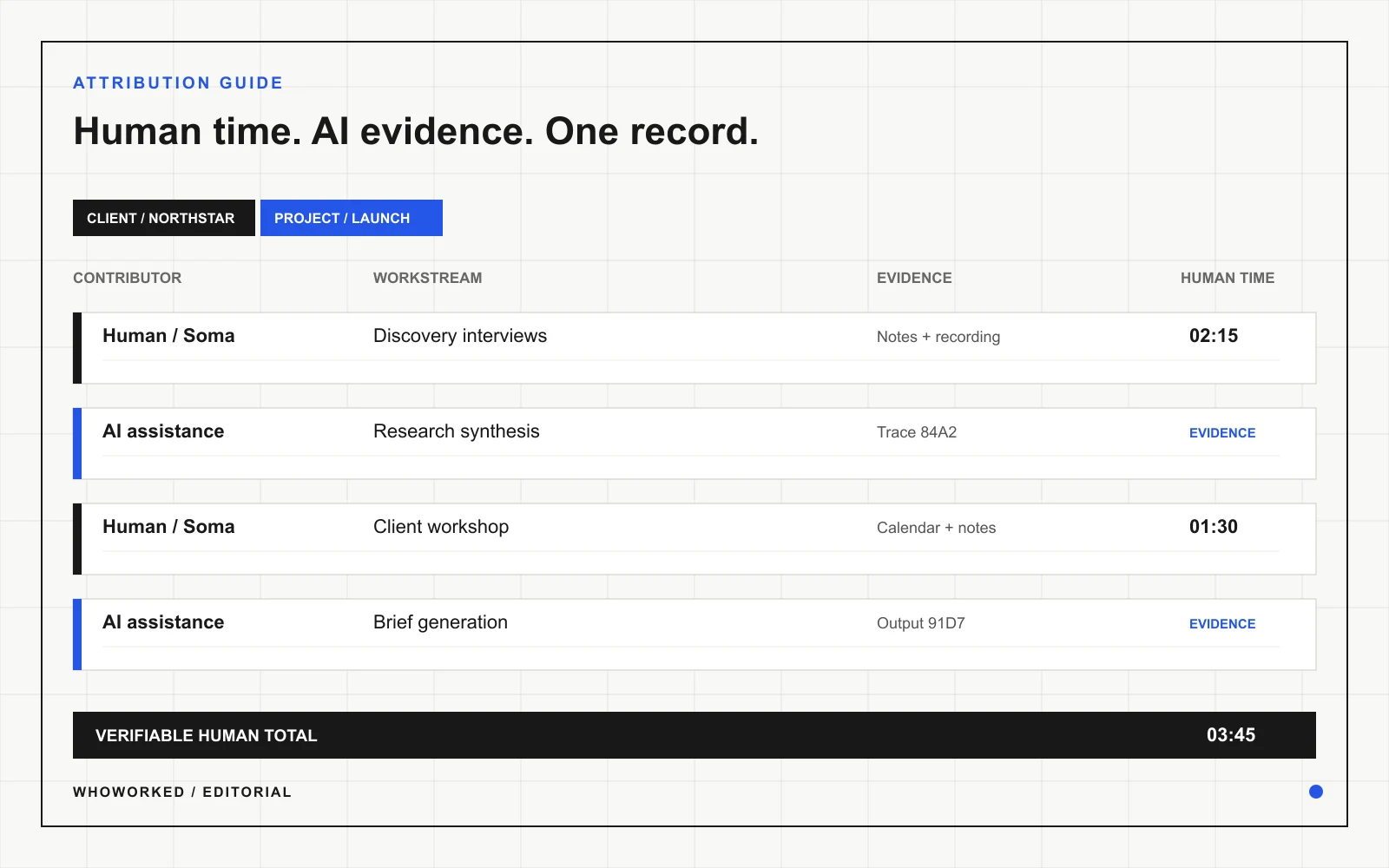
AI can draft a campaign, summarize discovery calls, generate test cases, and prepare a first pass of a client report. A person still frames the problem, supplies context, reviews the result, and takes responsibility for what ships. Useful attribution records both parts without pretending that every contribution is the same kind of work.
Start with the decision you need to make
Attribution is not an abstract accounting exercise. Teams need it to estimate future work, explain invoices, protect margins, plan capacity, and understand where AI improves delivery. If a record cannot answer one of those questions, adding more detail will usually create noise rather than insight.
Choose one consistent unit of analysis: a client project and the workstream within it. The project establishes the commercial or internal outcome. The workstream describes the kind of effort, such as research, design, implementation, quality assurance, or client communication. This keeps attribution attached to work people already recognize.
Capture four pieces of context
First, record ownership. Name the person responsible for the entry even when an AI assistant produced part of the output. Ownership tells reviewers who supplied judgment, checked constraints, and approved the work. It also avoids the unhelpful idea that a model independently delivered work to a client.
Second, record elapsed human effort with the same timer or manual entry used for other work. Include preparation, prompting, review, correction, and integration. Exclude unattended processing time unless a contract or operating process explicitly treats it as a billable resource.
Third, classify the entry under the correct workstream. An AI-assisted competitive review belongs in research, not in a generic AI bucket. The assistance method matters, but the business purpose matters more. Stable workstreams make reports comparable before and after a team changes tools.
Fourth, leave a short outcome note. Write what changed or moved forward: three interview summaries synthesized, migration test plan reviewed, or landing page variants prepared for client selection. This is more useful than logging prompt fragments, model names, or a vague note such as used AI.
Project: Acme website refresh
Workstream: Research
Owner: Maya
Duration: 1h 20m
AI involvement: Assisted
Outcome: Synthesized 12 interview notes and verified five recurring themes against source calls.
Use a small set of involvement levels
A long taxonomy will collapse under everyday use. Most teams can work with three levels: no material AI involvement, AI assisted, and AI led with human review. The labels should describe the delivery process, not judge quality. A careful team may produce excellent work at any level.
- No material involvement means AI did not meaningfully affect the delivered result. Autocomplete or routine spell-checking does not need a special attribution entry unless your policy requires it.
- AI assisted means a person directed the work and used AI for a bounded part of the process, such as ideation, transformation, analysis, or drafting.
- AI led with human review means the first substantial output came from AI, while a named person validated facts, fit, risks, and final quality before delivery.
Review patterns, not individual prompts
After several weeks, compare similar workstreams. Look for changes in human duration, rework, throughput, and outcomes. A lower duration is valuable only when quality and client confidence hold. A faster first draft that creates more review cycles may move effort rather than remove it.
Use the record for coaching rather than surveillance. Ask what context helped, where review caught errors, and which repeatable steps deserve a shared workflow. Do not rank people by how often they select AI assisted. Different roles, clients, and risk levels require different operating choices.
Write the policy in plain language
A practical policy can fit on one page. State when AI involvement must be recorded, which involvement levels are available, what information must never enter a model, who reviews client-facing work, and how attribution appears in reports or invoices. Add examples from real workstreams so the policy is easy to apply.
Good attribution does not turn delivery into a forensic exercise. It creates a trustworthy record of who took responsibility, where time went, how AI contributed, and what the team accomplished. Start with a small model, review the data with the people doing the work, and refine only when a real decision requires more detail.